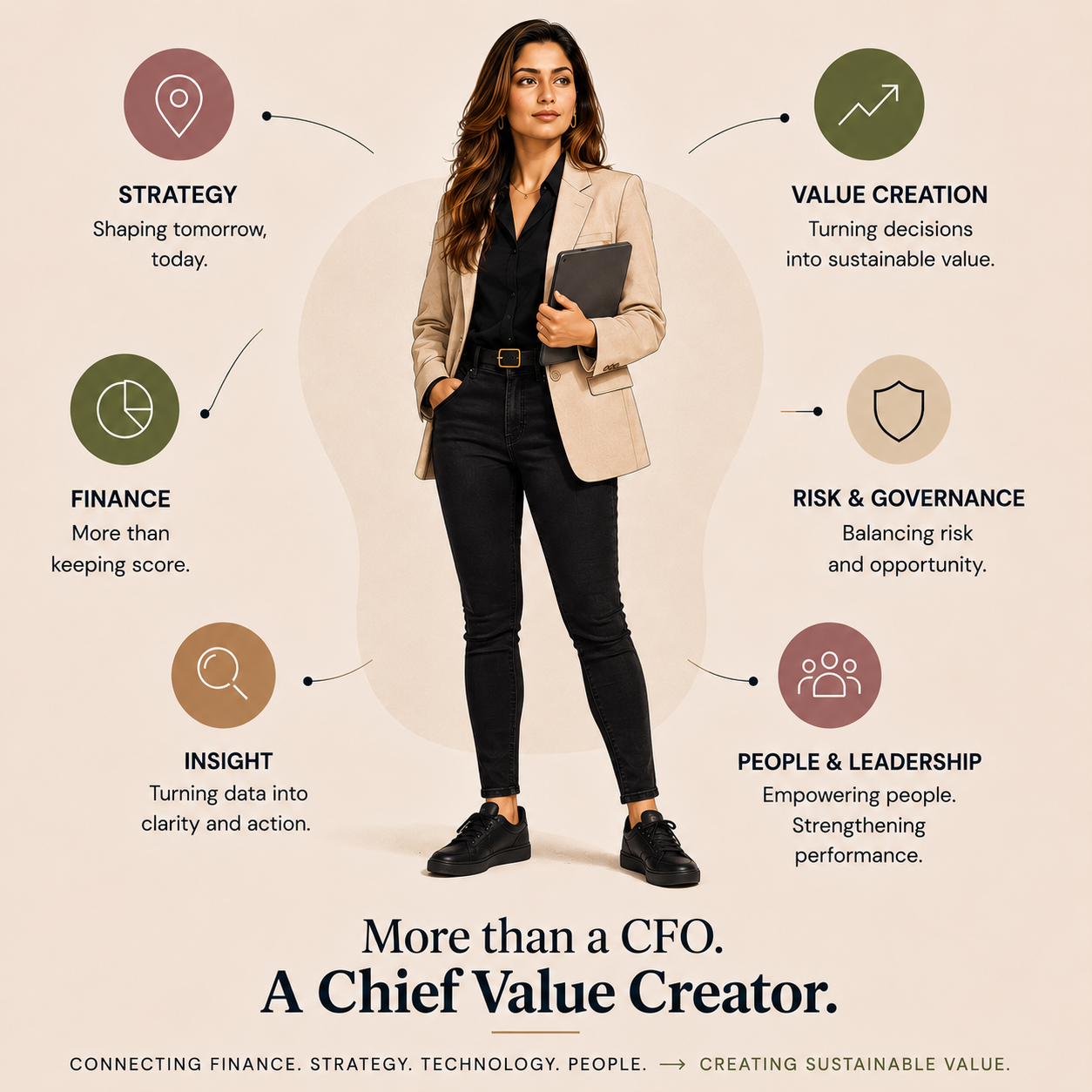
The role we still call "CFO" was shaped for a company that, in many sectors, no longer exists: one that was stable, predictable, and could be steered largely by looking in the rear-view mirror. Most of the organizations I work with are none of those things.
For decades, the chief financial officer was understood as the steward of the numbers: closing the books, reporting to the board, safeguarding controls, and keeping the organization solvent and compliant. All of that still matters. But it describes only a fraction of what finance leadership actually has to do in a business that is scaling quickly, entering new markets, integrating acquisitions, or operating under constant regulatory scrutiny.
A mandate built for stability
The traditional mandate quietly assumed a few things: that revenue was reasonably predictable, that technology changed slowly, and that finance sat downstream of strategy, measuring decisions after they had been made elsewhere.
In fintech and payments, where I have spent much of my career, none of those assumptions hold. Product, risk, regulation and capital are deeply interconnected. A pricing decision is a compliance decision is a technology decision is a margin decision, often in the same conversation.
When the business moves at that speed, a finance function that only keeps score will always be a step behind. The questions that determine whether a company wins are being asked long before the numbers exist.
Finance sits at the intersection now
Finance, business intelligence, compliance, IT governance and risk no longer live in separate boxes, and perhaps they never truly did. The organizations that struggle most are often the ones still treating them as if they do, asking finance to validate decisions rather than helping shape them.
Over the past twenty years, I have had the opportunity to work with and gain insight into more than 100 organizations across different sectors, leadership teams and growth stages. What those experiences taught me is that organizational challenges are rarely isolated to finance alone. More often, they sit at the intersection of people, systems, governance, technology and decision-making, and that is where the most important conversations tend to happen.
The value of wearing several hats
I have never sat in a single-function seat. Across my career, I have carried responsibility for finance, business intelligence, compliance and IT governance at the same time, and I have come to see that breadth as the point of the role, not a complication of it. The seat is most valuable precisely when it refuses to stay in one lane.
What finance leaders bring to the table is not only technical expertise. It is a way of seeing the whole system: understanding how decisions made in one corner of the business can emerge months later as risk, opportunity or value somewhere else entirely.
What this looked like in practice
In my experience, some of the clearest value I created did not come from the finance work itself. It came from the moments I could step sideways: sitting with the business intelligence team to run a specific analysis, reconciling data across systems that no one had thought to connect, or challenging assumptions that had quietly become accepted truths.
More than once, that work recovered or unlocked millions: revenue that had been leaking unnoticed, costs that did not reconcile, or value that remained hidden because no one was looking across the full process.
In one instance, a cross-functional data reconciliation exercise uncovered significant revenue leakage that had gone undetected for years. The solution itself was not particularly complex. The challenge was that no one had been looking across the entire chain.
What stayed with me was not the result, but how easily it could have been missed. These were not heroic projects. They were often the result of a few days of focused, cross-functional attention. The constraint was rarely the opportunity itself. It was time.
From keeping score to creating value
The real contribution of this seat is not control for its own sake. It is the ability to see the bigger picture: to understand where genuine risk sits and where it only appears to, and to balance risk and reward so that investment decisions create value rather than simply pass review.
That is a fundamentally different posture from the one the traditional CFO mandate describes. It is the difference between a finance function that protects the company and one that helps it grow intentionally. The best outcomes I have been part of came from finance being in the room early, not as the brake but as the person who could see how the whole system fit together.
What this means for the companies that need it most
The businesses that benefit most from modern finance leadership are often the very ones that struggle to justify a full-time CFO: scale-ups, founder-led businesses, multi-entity groups and organizations navigating significant change. In my experience, a few things matter more than the title on the door:
- Bring finance leadership in early, when strategy is being formed, not after the numbers arrive.
- Look for breadth, not just technical depth: someone fluent across finance, risk, technology, governance and operations.
- Ask the role to shape decisions, not merely report on them.
- Value the ability to translate complexity into clarity that leadership teams can act upon.
None of this requires a larger finance team. It requires a broader definition of what finance leadership is for.
Beyond the Chief Financial Officer
The title on the door may still say Chief Financial Officer. Increasingly, however, the organizations that create the most value are looking for something broader: a leader who can connect finance, strategy, technology, governance and people.
Someone who can translate complexity into clarity, challenge assumptions, strengthen decision-making and help organizations scale with confidence.
Perhaps it is time we started talking less about the Chief Financial Officer and more about the Chief Value Creator. Because in the businesses that need it most, that is where the real value of the role now lives.
The title on the door still says CFO. The work, in the businesses that need it most, is considerably wider than that, and that is exactly where its value lives.
If this resonates with where your organization is right now, I am always glad to have the conversation.