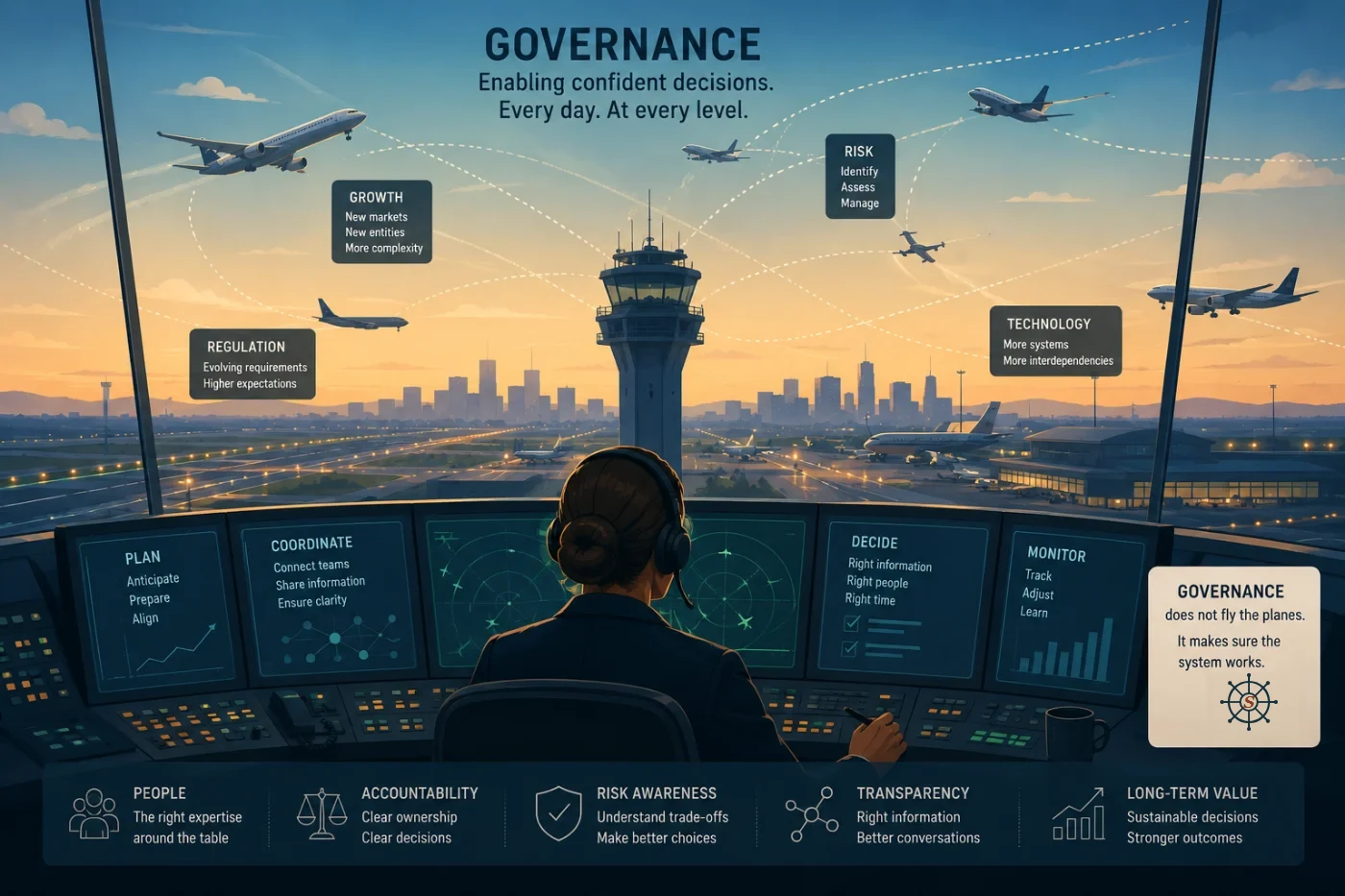
Governance has a branding problem. Mention the word in a leadership meeting and people often think of policies, committees, approvals and compliance. In fast-growing organizations, governance is frequently perceived as something that slows the business down rather than helping it move forward.
Having spent much of my career as auditor and CFO in regulated payments environments, I understand where that perception comes from. I have also learned that it is usually wrong.
One of the most consistent observations throughout my career is that the organizations that benefit most from governance are often the ones that resist it the longest. Not because governance lacks value, but because its value only becomes visible once complexity arrives.
Governance becomes important when growth changes the game
In the early stages of a company, governance often feels unnecessary. Decisions are made quickly. Communication is informal. Founders remain close to the business. Teams are small enough to align naturally. The organization functions because talented people compensate for the absence of structure.
As businesses grow, however, complexity increases. New entities are created. New markets are entered. Acquisitions take place. Technology landscapes become more complex. Regulators become involved. What once lived inside the heads of a few individuals now needs to become embedded within the organization itself.
Yet many companies continue to operate as if nothing has changed. In my experience, governance discussions rarely start because someone suddenly develops a passion for governance. They usually start because growth exposes weaknesses that previously remained hidden.
Decision-making becomes unclear. Responsibilities overlap. Critical information is fragmented. The organization starts depending on a small number of individuals to connect the dots. That is often the point where governance enters the conversation.
There is also a less comfortable reason governance meets resistance. Transparency creates accountability, and not everyone welcomes it. When ownership, performance and quality become visible, it is no longer possible to hide behind ambiguity. In some organizations, the absence of governance quietly suits the people who would rather not be held accountable for the decisions they make or the results their area delivers. Resistance to governance is not always about speed. Sometimes it is about who prefers to remain unseen.
Governance is not about control
One lesson became increasingly clear to me over the years. Governance is often described as a control mechanism. I have come to see it differently.
Good governance is a decision-making framework. Its purpose is not to create more rules. Its purpose is to create clarity: clarity around ownership, around accountability, around risk, and around escalation.
The strongest governance structures do not slow organizations down. They allow organizations to make better decisions with greater confidence. In fact, many governance problems are not governance problems at all. They are decision-making problems disguised as governance problems.
What regulation taught me
Working in regulated financial services environments reinforced this view. Over the years, I have been involved in governance frameworks, regulatory interactions, compliance oversight and, more recently, initiatives related to DORA and operational resilience.
Interestingly, the biggest challenge was rarely understanding the regulation itself. The bigger challenge was creating alignment between different parts of the organization. Technology viewed issues through one lens. Compliance through another. Risk through another. The business through yet another.
The organizations that performed best were not necessarily those with the most policies. They were the organizations that connected these perspectives and translated them into clear decisions and clear accountability.
That is why I increasingly believe that compliance creates limited value in isolation. Governance creates value when it improves the quality of decisions.
Governance as infrastructure
Looking back across more than twenty years and over one hundred organizations I have had the opportunity to observe from the inside, I have rarely seen growth fail because governance was too strong.
I have, however, seen organizations struggle because governance had not evolved alongside the business. Because responsibilities remained informal. Because key decisions depended on a handful of individuals. Because information was fragmented across teams and systems. Because growth outpaced the organization's ability to coordinate itself.
The strongest organizations treat governance differently. They see it as infrastructure. Just as technology infrastructure enables scale, governance infrastructure enables decision-making at scale.
Final thought
The paradox remains. The companies that need governance the most often resist it the longest. Not because governance slows growth, but because its benefits are often invisible until complexity arrives.
The best leadership teams understand this earlier. They do not build governance because regulators expect it. They build governance because sustainable growth eventually depends on it.
Governance should not be viewed as the opposite of entrepreneurship. When designed well, it is one of the things that allows entrepreneurship to scale.
If this resonates with where your organization is right now, I am always glad to have the conversation.