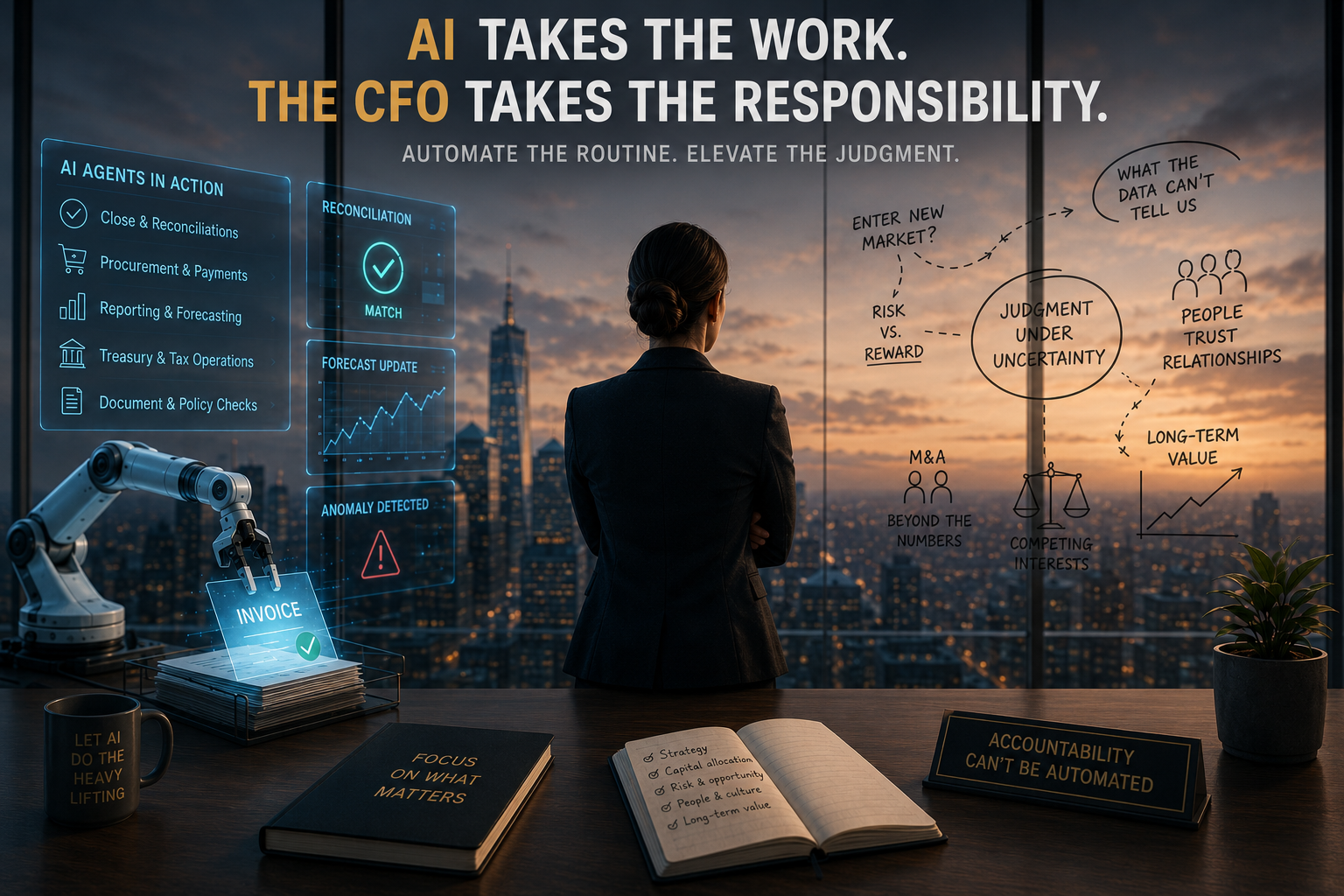
When I read the announcement, I did not feel what the headlines wanted me to feel. PwC, the firm where I spent my first decade, has built a whole practice around rebuilding finance with AI, and most of the coverage frames it as the end of the CFO. I have run finance teams ever since I left, and I see it differently. Yes, AI is about to take over a real chunk of the work. But it is not the chunk that ever made the role matter.
In May, PwC announced a collaboration with OpenAI to build an AI-native finance function built around the office of the CFO. A few days later it announced almost the same thing with Anthropic. The promise in both is identical: AI agents that handle the routine rhythms of finance, from planning and forecasting to procurement, payments, treasury, tax and the close, with people still in the loop.
There is a real idea underneath the press releases, and that is why I wanted to write down what I actually think instead of firing off a quick comment. So let me be specific about what a setup like this can genuinely take off your plate, and what it cannot.
What is actually being built
It helps to know what they are actually building, because it is not a chatbot bolted onto your ERP. The clever part is the operating model. OpenAI is using its own finance team as the first customer, building a procurement agent in-house before taking anything near a client. The figures it shared are unusually concrete for this kind of announcement: roughly five times more contracts processed by the same team, and more than 200 investor interactions handled during a recent fundraise.
What interests me is the pattern, not the statistics. Finance is close to the perfect place to test this. The work is repetitive enough to automate, yet sensitive enough that governance, approvals and a clear audit trail have to be there from the first day. That tension is exactly what I have lived with my whole career, so I am not going to wave the announcement away.
What AI genuinely can take over
I would rather be honest than defensive here. A large part of what finance teams do every day is repetitive, rules-based and buried in documents, and that is where agents are good:
- The close and the plumbing. Reconciliations, accruals, journal entries, variance analysis, month- and quarter-end preparation. The work that consumes the most hours and produces the least debate.
- Document-against-policy checks. Reviewing contracts and invoices against policy, flagging exceptions, triaging the routine from the unusual.
- Procurement and payments monitoring. Intake, requisitions, policy questions, watching payment flows and surfacing anomalies before they compound.
- Reporting and forecasting mechanics. Assembling reporting materials, refreshing forecasts as conditions change, preparing first drafts of the board pack.
- Treasury and tax operations. The structured, recurring elements that follow known rules and known calendars.
Let me give the strongest example I know for this technology. Some of the most valuable work I have ever done had nothing to do with the finance role itself. It came from stepping sideways. One case: a cross-functional data reconciliation that recovered close to a million in revenue that had been leaking, unbilled, for years. The fix was not complicated. What was missing was time, and the simple fact that nobody had been looking across the whole chain.
That is the kind of work I want AI to do. An agent that watches the whole chain all the time, that never gets tired and never pushes the reconciliation aside because the board pack is due, is worth a great deal. I do not see that as a threat to the role. It finally gives the role back the hours it never had for the work that actually moved things.
What it structurally cannot take over
This is also where the "replace the CFO" story starts to fall apart for me. The hardest and most valuable parts of the job are not workflows at all. They are the judgment calls you make with incomplete information, competing interests and real consequences. AI can inform those calls. It cannot carry them for you.
Judgment under genuine uncertainty
An agent works towards a goal you define, using the data it can see. But the decisions that decide whether a company wins are usually made before that data exists. Whether to enter a market. How to price into a segment nobody has served yet. When a risk that has never been run is worth taking anyway. A model learns from the past and it is weakest at the exact moment the future stops resembling it, which is precisely when finance leadership earns its keep.
Trust, relationships and accountability
I have held a business steady through three CEO changes in a row. None of that was a workflow. It was trust, built up with a board, shareholders and a management team over years and it was someone being willing to put their own name and license on the line. You cannot hand that to an agent. A regulator, an audit committee or an investor in a data room is not looking for an output. They are looking for a person who will answer for it.
Negotiation and the human side of M&A
I have led acquisitions where the whole deal came down to a single conversation with a founder, not to a synergy model. The numbers set the edges of what was possible. The result came from reading the person on the other side of the table, working out what they actually needed, and building a structure they could live with. And the integration afterwards stood or fell on people and trust long before any systems lined up. You do not automate that.
Seeing the whole system
The value of this seat was never control for its own sake. It is being able to see how a decision in one corner of the business shows up months later as risk, or opportunity, or value somewhere completely different. That instinct for the whole system, the shift from Chief Financial Officer towards something closer to a Chief Value Creator, only becomes more important as the mechanical work disappears.
And now the CFO has to govern the AI too
There is a quiet irony in the "AI replaces finance" story. As these agents spread, finance picks up a new job: governing the AI itself. Someone has to keep an eye on how much AI is being used, what it costs in tokens and where the spend is heading and run all of that like any other operating cost. Someone has to build the controls that catch a confident, wrong answer on a tax position or a compliance question before it becomes a real problem. That someone is the CFO.
AI will not remove the need for a CFO. If anything it raises the bar, because now you answer for the machine as well.
Even the firms selling these tools admit as much in their own words: human supervision, human oversight, human-governed actions. In their picture, finance people stop running the processes themselves and start supervising, governing and improving the agents that do. To me that reads as a bigger job, not a smaller one.
What this means for the companies I work with
For the founder-led businesses, scale-ups and multi-entity groups I work with, the takeaway is not "buy AI" or "fear AI". It is more practical than that:
- Automate the rhythm, not the judgment. Point agents at the repeatable, measurable and painful workflows (for example: close, reconciliations, intake and exception handling). Start with one, instrument it and design the exception path before you automate anything.
- Design the governance first. Define what an agent may do autonomously, what requires a human and how every action is logged and auditable. In regulated environments this is not optional, and it is finance's job.
- Reinvest the hours you free up instead of quietly banking them as headcount savings. The real prize is the same people finally having time for the cross-functional work that finds leaking revenue and shapes decisions early.
- Value breadth and judgment more, not less. As the mechanical work gets absorbed, what is left is the part that was always the point: someone fluent across finance, risk, technology and governance who can turn complexity into a decision.
PwC did not build a unit to replace the CFO. It built one to automate the parts of finance that never really needed a CFO in the first place. What is left, the judgment, the trust, the accountability, the ability to see the whole system, is not a workflow you can hand to an agent. That part is the job.
If you are thinking about where AI fits in your own finance function, and where it does not, I am always glad to have the conversation.